The Biblical Patriarchs and the Birth of Israel
c. 2000–1200 BC. The family story first. Abraham, the patriarchs and the Exodus belong to biblical tradition, and their dates are not independently established; they are given here as the tradition places them.[10][11]
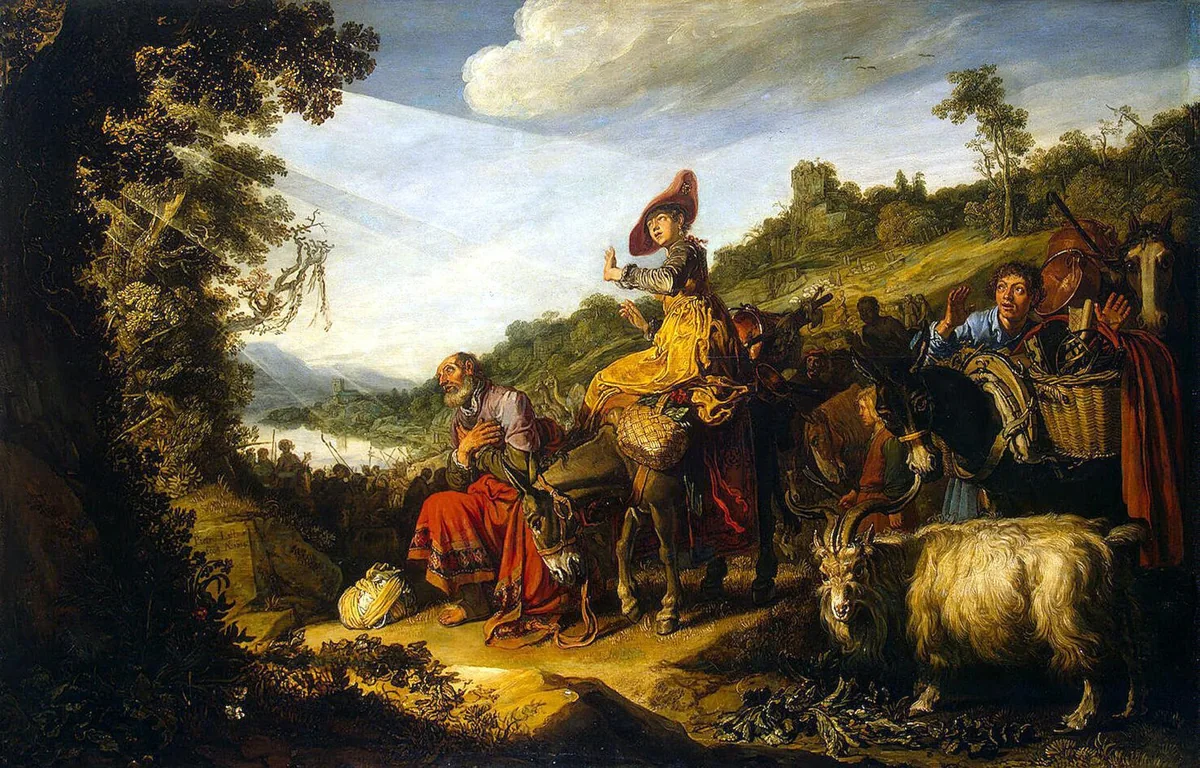

- c. 2000 BC
1. Abraham – the father of the Jewish people
Biblical tradition- According to biblical tradition, Abraham (originally Abram) was born in Mesopotamia, traditionally associated with Ur.
- God called Abraham to leave his homeland and travel to Canaan, and made a covenant promising him descendants, a land and a special relationship with God.
- His wife was Sarah; their son Isaac was born when both were elderly.
- Abraham is the founding patriarch of the Jewish people and an important figure in Christianity and Islam. Genesis 11–25.[10]
- c. 1950–1800 BC
2. Isaac and Jacob
Biblical tradition- Isaac inherited the covenantal promise and married Rebekah; their twin sons were Esau and Jacob.
- Jacob later received the name Israel. His twelve sons, among them Reuben, Simeon, Levi, Judah, Joseph and Benjamin, became the traditional ancestors of the Twelve Tribes. Genesis 25–36.[11]
- c. 1800–1600 BC
3. Joseph and the Israelites in Egypt
Biblical tradition- Joseph, sold into slavery by his brothers, rises to be a powerful official under Pharaoh.
- A severe famine brings Jacob and his family to Egypt, where they settle in Goshen and, in the biblical narrative, multiply considerably. Genesis 37–50.[11]
- traditional date c. 1446 or 1250 BC
4. Moses, the Exodus and the giving of the Law
Biblical tradition- According to Exodus, the Israelites are subjected to forced labour. Moses is called by God to lead them out; the Ten Plagues precede Pharaoh’s decision to release them.
- The Exodus becomes the central story of Jewish liberation, commemorated every year at Passover.
- At Mount Sinai, God gives Moses the Torah, including the Ten Commandments, and the Israelites enter into a covenant.
- The exact historical date, and the archaeological evidence for the Exodus, remain debated. Exodus, Leviticus, Numbers, Deuteronomy.[11]
- c. 1200 BC
5. Joshua, the Judges and the first record of Israel
Tradition, then inscription- Joshua succeeds Moses. The Israelites enter Canaan, the land promised to Abraham, and settle as a loose confederation of tribes. Judges including Deborah, Gideon and Samson lead them. Joshua, Judges. The biblical sequence should not be confused with a fully confirmed archaeological timetable.
- Firm evidence arrives from outside the Bible: an Egyptian inscription, the Merneptah Stele (c. 1208 BC), names a people generally identified as Israel in Canaan. It is among the earliest external references to Israel.[14]
The United Kingdom of Israel
c. 1050–930 BC. The biblical account gives Israel a single monarchy. Historians debate the size and organisation of the kingdom, so these reign dates are traditional and approximate.[11]
- c. 1050–1010 BC
6. King Saul
Approximate- The tribes increasingly seek a central monarchy, and Saul becomes the first king of Israel in the biblical account.
- He fights the Philistines and other neighbours and lays the foundations of Israelite kingship.
- c. 1010–970 BC
7. King David
Approximate- David succeeds Saul and, in the famous account, defeats Goliath.
- He unites the tribes under one monarchy, captures Jerusalem and makes it his capital — the political and religious centre of the kingdom.
- His dynasty becomes central to Jewish messianic expectations.
- c. 970–930 BC
8. King Solomon and the First Temple
Approximate- Solomon is remembered for wisdom, wealth and building projects, above all the First Temple in Jerusalem, the principal centre of Israelite worship.
- His reign is traditionally recalled as a time of prosperity. After his death, political tensions divide the kingdom. 1 Samuel, 2 Samuel, 1 Kings, 1 Chronicles.[11]
The Divided Kingdoms and the First Exile
930–539 BC. Two small states beside much larger powers. Losing a king is one thing; losing the city and Temple around which public life is organised is another.[11]
- c. 930 BC
9. The kingdom divides
Approximate- Northern kingdom – Israel. Capital Samaria (founded by Omri in the 9th century BC). Traditionally associated with ten tribes and ruled by a succession of dynasties.
- Southern kingdom – Judah. Capital Jerusalem. Principally Judah and Benjamin; it keeps the Temple and the Davidic dynasty until the Babylonian conquest.
- 722–720 BC
10. The northern kingdom falls to Assyria
Conquest- Assyria conquers Israel and Samaria falls. Many inhabitants are deported across the Assyrian Empire; the traditions of the “Ten Lost Tribes” grow from these events, while other Israelites remain in the land.
- 8th–7th centuries BC
11. Judah survives
Kingdoms- Judah continues for more than a century after Israel’s fall. Hezekiah and Josiah are among its kings; in 701 BC the Assyrian king Sennacherib besieges Jerusalem.[5]
- The prophets Isaiah, Jeremiah, Micah and others warn against injustice, idolatry and political corruption.
- 597 and 587/586 BC
12. Babylon destroys the First Temple
Exile- Babylon under Nebuchadnezzar II captures Jerusalem in 597 BC and deports part of the population;[16] a decade later it destroys the city and the First Temple. Judah ceases to be an independent monarchy.
- Many Jews are deported to Babylon — the Babylonian Exile. Jewish religious identity and communal life now continue outside the land. 2 Kings 24–25; Jeremiah; Ezekiel; Lamentations.[11]
The Return from Exile and the Second Temple
539 BC–70 AD. Return does not mean that everyone comes back. Jewish life now has more than one centre — a pattern that outlasts Persia, the Greeks and Rome.[9][11]
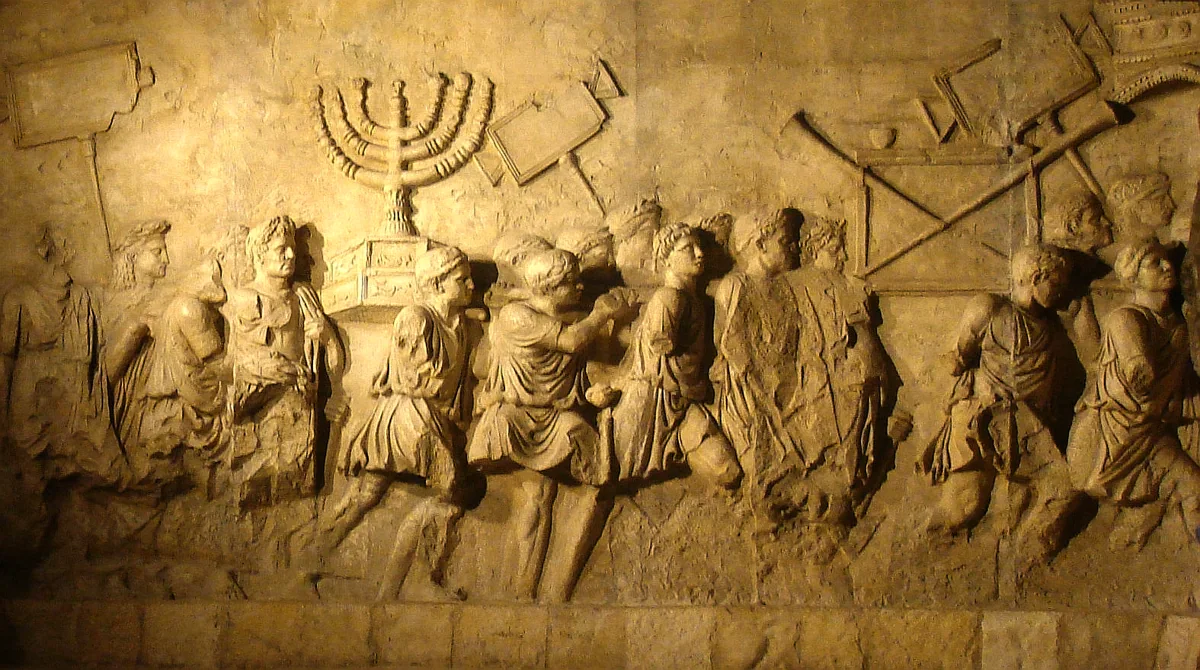

- 539–538 BC
13. Cyrus and the return
Return- The Persian Empire conquers Babylon in 539 BC. King Cyrus permits Jewish exiles to return; some do, and rebuilding of the Temple begins.
- c. 516 BC
14. The Second Temple is completed
Rebuilding- Jerusalem is again the principal religious centre. Ezra promotes the teaching of the Torah and Nehemiah helps rebuild the city’s walls (5th century BC), firming up Jewish religious and communal institutions.[5]
- 539–164 BC
15. The Persian and Hellenistic periods
Hellenistic period- Judah remains under Persian authority until Alexander the Great conquers the region in 332 BC. Competing Greek successor kingdoms — the Ptolemies and Seleucids — follow.[5]
- Greek language and culture influence Jewish society, the Torah is translated into Greek, and Jewish communities develop across the eastern Mediterranean.
- 167–164 BC
16. The Maccabean revolt
Revolt- The Seleucid ruler Antiochus IV restricts Jewish religious practice. Resistance under Mattathias and his son Judas Maccabeus recovers and rededicates the Temple — commemorated at Hanukkah.
- 140–63 BC
17. The Hasmonean kingdom
Self-government- Jewish independence is restored under the Hasmonean dynasty, with Jerusalem as capital, and the kingdom expands. Internal political and religious divisions and rivalries weaken it.
- 63 BC
18. Roman rule begins
Roman conquest- Pompey enters Jerusalem and Judea comes under Roman influence; independence is progressively reduced. Herod the Great becomes king in 37 BC, and direct Roman administration of Judaea follows in 6 AD.[11]
- There is no single day on which all of Roman rule arrives: the conquest, the client kings and the provincial governors are separate stages.
- 37–4 BC
19. Herod the Great and the Temple expanded
Client king- Herod enlarges the Second Temple into one of the most impressive religious complexes of the ancient world, and builds fortresses, palaces and ports. A magnificent Jerusalem does not make the country independent.
- c. 4 BC–30 AD
20. Jesus and the emergence of Christianity
Context- Jesus is born into a Jewish family in Roman-controlled Judea, and his ministry takes place within the Jewish religious world of the first century.
- His followers form the early Christian movement, which develops from its Jewish origins into a separate religion. This period matters to both Jewish and Christian history.[5]
- 66–70 AD
21. The Great Jewish Revolt and the destruction of the Second Temple
Revolt- Resistance to Rome erupts into major revolt in 66 AD. Titus besieges Jerusalem; in 70 AD the city is captured and the Second Temple destroyed, ending the sacrificial system. Resistance continues to 73 AD.[11]
- The Western Wall survives as part of the retaining structure of the Temple Mount complex.
The Rabbinic Period and the Jewish Diaspora
70–636 AD. After 70 AD, learning, prayer and communal life become the ways Judaism is carried forward. The familiar shorthand that Rome expelled every Jew and the diaspora began overnight is misleading — see A people with many homes.
- 70–200 AD
22. The development of Rabbinic Judaism
Rabbinic Judaism- Jewish religious leadership reorganises. Rabbis become increasingly important; synagogues and Torah study become central.
- Rabbi Yohanan ben Zakkai is a key figure in reorganising Jewish learning, and the foundations of classical Rabbinic Judaism are laid.
- 132–135 AD
23. The Bar Kokhba revolt
Revolt- Simon Bar Kokhba leads a second major revolt and briefly establishes an independent administration.
- Hadrian’s forces crush it. Jerusalem becomes the Roman colony of Aelia Capitolina; Jewish access is severely restricted for a period, and many Jews are killed, enslaved or displaced.
- c. 200 AD
24. The Mishnah
Text- Rabbi Judah ha-Nasi (Judah the Prince) compiles and organises the oral legal traditions into the Mishnah, a foundational text of Rabbinic Judaism. Scholarship develops in academies in the Land of Israel and Babylonia.[11]
- c. 400–500 AD
25. The Jerusalem and Babylonian Talmuds
Text- Scholars produce extensive commentary on the Mishnah: the Jerusalem Talmud in the Land of Israel and the Babylonian Talmud in the academies of Mesopotamia. The Babylonian Talmud becomes the most influential source of rabbinic law and discussion; it takes shape over a long period, so c. 500 AD is a landmark, not a publication date.
- These centuries transform Judaism into the religious civilisation that sustains communities in many countries.
- 330–636 AD
26. Jewish life under the Byzantine Empire
Byzantine period- As Christianity gains influence in the Roman and Byzantine empires, restrictions are imposed on Jewish life at various times. Communities nevertheless survive in the Land of Israel, Mesopotamia, North Africa and elsewhere, and synagogues and schools keep developing. The diaspora is by now geographically widespread.
The Islamic Empires and the Medieval Jewish World
636–1492 AD. A story of scholarship and flourishing, and of persecution and expulsion, often within the same century.
- 636–750
27. The Muslim conquests and the beginning of Islamic rule
Islamic rule- Arab Muslim armies conquer Jerusalem (c. 636–638) and the region becomes part of the Islamic Empire; the Dome of the Rock follows in the late seventh century.[5]
- Jews are generally recognised as People of the Book, with protected but subordinate status as dhimmis. Conditions vary considerably between rulers and territories.
- 750–1100
28. The Golden Age of Jewish scholarship
Culture- Baghdad becomes an important centre of Jewish scholarship. Jewish scholars develop Hebrew grammar, biblical interpretation, philosophy and law; Jewish merchants take part in international trade; Hebrew poetry flourishes; communities grow in Spain, North Africa, Egypt and the Middle East.
- Important figures include Saadia Gaon, Dunash ben Labrat, Solomon ibn Gabirol and Samuel ha-Nagid.
- c. 900–1200
29. The Jewish Golden Age in Muslim Spain
Culture- Jews in parts of Muslim-ruled Al-Andalus take part in philosophy, medicine, science, poetry and government. Hebrew literature reaches new heights, and Córdoba, Granada and other cities become centres of learning.
- 1138–1204
30. Maimonides
Figure- Moses ben Maimon — Maimonides, the Rambam — is born in Córdoba and becomes one of the most influential Jewish thinkers in history.
- His Mishneh Torah organises Jewish law comprehensively; his Guide for the Perplexed is a major work of Jewish philosophy on the relationship between faith, reason and religious law.
- 1096 onwards
31. The Crusades and Jewish persecution
Persecution- The First Crusade begins in 1096 and crusading armies attack Jewish communities in the Rhineland; Mainz, Worms and Speyer suffer massacres. Subsequent crusades bring more persecution.
- Crusaders take Jerusalem in 1099, beginning a period of Christian rule that ends when Saladin retakes it in 1187.[5]
- 12th–15th centuries
32. Expulsions from Western Europe
Expulsion- Jews are expelled from England in 1290; France sees several expulsions and readmissions; communities face persecution in parts of Germany.
- In Spain, anti-Jewish violence erupts in 1391, forced conversions increase, and the Spanish Inquisition is established in 1478.
- 1492
33. The expulsion from Spain
Expulsion- Ferdinand and Isabella issue the Alhambra Decree: Jews who refuse conversion must leave. Thousands of families go, many settling in the Ottoman Empire, North Africa and Italy, and Sephardi communities take root across the Mediterranean world.
- One of the most consequential events in diaspora history.[11]
The Early Modern Jewish World
1492–1800. Refuge in the Ottoman world, a great community in Poland-Lithuania, then crisis and renewal.
- 1500–1700
34. Jewish life in the Ottoman Empire
Ottoman world- The Ottoman Empire, which takes over Jerusalem and the region in 1517,[5] becomes a major refuge for Sephardi Jews, with communities in Constantinople, Salonika, Safed and elsewhere. Printing, study and commerce expand.
- Safed in Galilee becomes a centre of Jewish mysticism; Rabbi Isaac Luria, the Ari, profoundly influences Kabbalah.
- 1500–1700
35. Eastern Europe
Ashkenazi world- Jewish communities expand in Poland-Lithuania; communal institutions are well established, Yiddish develops as the language of Ashkenazi life, and rabbinic academies flourish. Jewish life becomes deeply rooted in towns and villages across Eastern Europe.
- 1648–1649
36. The Chmielnicki Uprising
Catastrophe- A Cossack uprising devastates Jewish communities in parts of Ukraine and the Polish-Lithuanian Commonwealth. Many are killed or displaced, with a lasting impact on Eastern European Jewish memory.
- 1626–1676
37. Sabbatai Zevi
Messianic crisis- Sabbatai Zevi proclaims himself the Messiah and wins wide support across the Jewish world. In 1666 he converts to Islam under Ottoman pressure, a major religious crisis for his followers.
- 18th century
38. Hasidism
Movement- The Baal Shem Tov founds the spiritual movement of Hasidism in Eastern Europe, emphasising devotion, prayer, joy and a personal relationship with God. It grows into numerous communities within Ashkenazi religious life.
- late 18th century
39. The Jewish Enlightenment – Haskalah
Enlightenment- Jewish intellectuals, led by Moses Mendelssohn, advocate secular education and engagement with European society. Communities debate modernity, tradition, language and emancipation, shaping later Jewish political and religious movements.
Emancipation, Nationalism and Modern Zionism
1800–1914. Equal citizenship arrives in Europe, and so does a new, political antisemitism. Modern Zionism changes the question from how Jews can live safely as minorities to whether they should have a national home.[12]
- 1791–1870
40. Jewish emancipation in Europe
Emancipation- The French Revolution and Napoleonic reforms spread ideas of civil equality; France grants Jews equal citizenship in 1791 and other countries gradually follow.
- Jews enter professions, universities, business and public life, and new movements develop, including Reform Judaism and modern Orthodox responses.
- late 19th century
41. The rise of modern antisemitism
Antisemitism- Prejudice survives emancipation, and political antisemitism develops in several countries. Pogroms in the Russian Empire from 1881 onwards drive mass migration: millions of Jews emigrate to the United States, Western Europe and elsewhere.
- 1882–1903
42. The First Aliyah
Aliyah- Larger numbers of Jewish immigrants, many from Eastern Europe and Yemen, arrive in Ottoman-ruled Palestine. They found agricultural settlements and new communities, and Hebrew begins to be revived as a spoken language.[12]
- 1896–1897
43. Theodor Herzl and political Zionism
Zionism- Herzl publishes Der Judenstaat (The Jewish State) in 1896, arguing that antisemitism requires a political solution.
- The First Zionist Congress meets in Basel in 1897, promotes a publicly recognised homeland for the Jewish people in Palestine, and establishes the World Zionist Organization.
- 1904–1914
44. The Second Aliyah
Aliyah- Another wave of immigration, mostly from the Russian Empire, brings new agricultural and collective settlements — the first kibbutzim — and the founding of Tel Aviv in 1909.
- 1914
45. The Jewish world on the eve of the First World War
Snapshot- Jewish communities are spread across Europe, North Africa, the Middle East and the Americas. Major centres include Eastern Europe and the Russian Empire, Germany and France, the United States, Ottoman Palestine, and North Africa and the Middle East.
The First World War, British Mandate and the Holocaust
1914–1945. Two promises of a home, and the destruction of European Jewish life. The Holocaust is a catastrophe in its own right, not merely a preface to the creation of Israel; Zionism predates it.[8][12]
- 1914–1918
46. The First World War
War- The Ottoman Empire joins the Central Powers. The British Empire captures Palestine (Jerusalem in 1917) and Ottoman rule ends. Jewish communities in Europe experience displacement and hardship.[5]
- 2 November 1917
47. The Balfour Declaration
Declaration- British Foreign Secretary Arthur Balfour declares support for a national home for the Jewish people in Palestine, while stating that the civil and religious rights of existing non-Jewish communities should not be prejudiced.[6]
- 1920–1948
48. The British Mandate for Palestine
Mandate- Britain administers Palestine under an international mandate, confirmed by the League of Nations in 1922, which incorporates the national-home commitment.[13]
- Jewish immigration and Jewish political, educational and economic institutions grow. The Mandate does not begin in an empty landscape: Palestinian Arab society has its own demand for independence, and Arab opposition to Zionism and immigration intensifies, with rising tension and violence.
- 1919–1939
49. The Third, Fourth and Fifth Aliyot
Aliyah- Immigration increases between the wars, with many arrivals from Eastern Europe and Germany. Tel Aviv grows into a major city, Hebrew becomes established in everyday life, and Jewish political and cultural institutions develop.
- 1933
50. The rise of Nazism
Nazism- Hitler becomes Chancellor in January 1933. The Nazi government introduces systematic discrimination: Jews are excluded from many professions and institutions, the Nuremberg Laws of 1935 strip them of key citizenship rights, and Jewish businesses and property are increasingly targeted.
- 9–10 November 1938
51. Kristallnacht
Pogrom- Nazi-organised violence devastates Jewish communities across Germany and Austria: synagogues are burned, businesses and homes destroyed, and thousands of Jewish men arrested and sent to concentration camps. Persecution becomes more violent and systematic.
- 1939–1945
52. The Second World War and the Holocaust
Genocide- The Holocaust, in Hebrew the Shoah, is the systematic genocide of Europe’s Jews by Nazi Germany and its allies and collaborators. Major stages:
- 1939 – Germany invades Poland. 1939–1941 – ghettos are established across occupied Eastern Europe. 1941 – mass shootings intensify after the invasion of the Soviet Union. 1942 – the Wannsee Conference coordinates the “Final Solution”; over 1942–1945 millions of Jews are deported to extermination camps. 1944 – Auschwitz-Birkenau becomes the site of the murder of hundreds of thousands of Jews. 1945 – Allied forces liberate the remaining camps.
- ≈ 6 million Jews were murdered — about two-thirds of Europe’s Jewish population. Communities that had existed for centuries were destroyed.[8]
- 1945–1947
53. Liberation and the Jewish refugee crisis
Aftermath- Survivors emerge from the camps and hiding places, many having lost their entire families. Hundreds of thousands live in displaced-persons camps, and many seek to emigrate to Palestine, the United States and elsewhere. The Holocaust strengthens international support for a Jewish homeland.[8]
The Establishment of the State of Israel
1947–1967. For Jews, statehood changes a fundamental condition of the long diaspora story. For Palestinians, the same years bring the Nakba. They are different experiences of one turning point, and a serious account leaves room for both.[7]
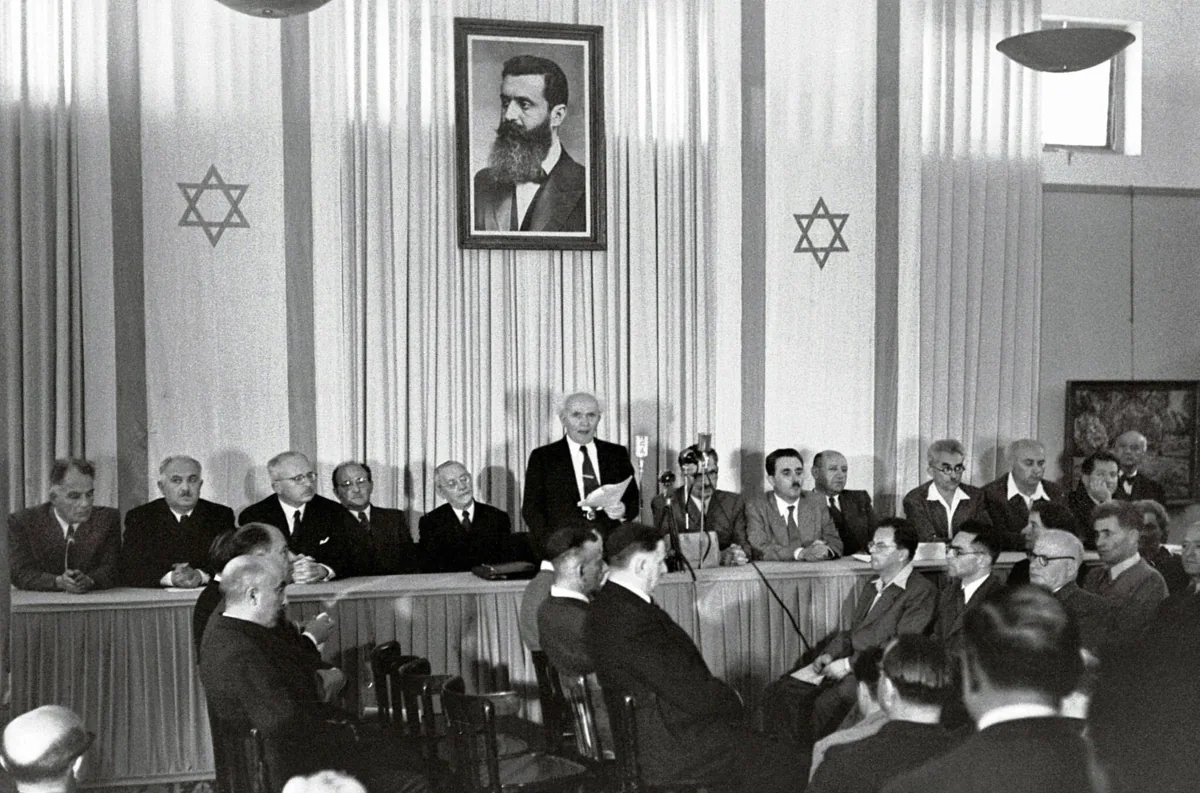

- 29 November 1947
54. The UN Partition Plan
United Nations- The General Assembly adopts Resolution 181, recommending division of Mandatory Palestine into Jewish and Arab states, with Jerusalem under international administration. Jewish leaders accept; Arab leaders reject it.[6]
- 14 May 1948
55. The establishment of Israel
Independence- David Ben-Gurion declares the State of Israel in Tel Aviv as the British Mandate ends. The United States and the Soviet Union are among the first to recognise it.
- Israel is the first sovereign Jewish state in nearly 2,000 years.[6]
- 1948–1949
56. The 1948 Arab-Israeli War
War- Armies from neighbouring Arab states enter the former Mandate territory. Israelis remember it as the War of Independence, fought for survival; armistice agreements follow in 1949, with Israel holding more territory than the UN plan allotted.
- Hundreds of thousands of Palestinian Arabs become refugees. Palestinians remember the same war as the Nakba — mass displacement and dispossession.[7]
- Regional rivalries also shaped the war — see Syria and the struggle over Greater Syria.
- 1948–1960s
57. Mass Jewish immigration
Aliyah- Hundreds of thousands of Holocaust survivors immigrate. Large communities from Iraq, Yemen, Egypt, Morocco, Libya, Tunisia and other Middle Eastern and North African countries also arrive; many left, or were forced to leave, countries where their families had lived for generations.
- Israel’s population expands rapidly, with new towns, agricultural settlements and absorption centres.
- 1956
58. The Suez Crisis
War- Israel, Britain and France attack Egypt after Egypt nationalises the Suez Canal. International pressure forces withdrawal, showing the changing balance of power in the Middle East.
- 5–10 June 1967
59. The Six-Day War
War- Israel fights Egypt, Jordan and Syria and captures the Sinai Peninsula, Gaza Strip, West Bank, East Jerusalem and Golan Heights. The Old City comes under Israeli control and Jewish access to the Western Wall is restored after 19 years.
- The war profoundly changes regional politics and the Israeli-Palestinian conflict; Israel’s later annexation of East Jerusalem remains internationally disputed.[13]
Israel and the Jewish World
1967–1999. Statehood does not end the region’s conflicts. Peace with neighbours is possible; peace with the Palestinians remains harder to settle.[12][13]
- 1973
60. The Yom Kippur War
War- Egypt and Syria attack on 6 October, on the holiest day in Judaism. Israel mobilises; the war ends in a ceasefire with major political and diplomatic consequences.
- 1979
61. Peace with Egypt
Peace- Anwar Sadat and Menachem Begin sign a peace treaty. Egypt becomes the first Arab country to formally recognise Israel, and Israel withdraws from Sinai — a turning point in Middle Eastern diplomacy.
- 1982
62. The First Lebanon War
War- Israel invades Lebanon during the Lebanese Civil War, stating the aim of removing the threat from Palestinian armed organisations there. Its forces reach Beirut, with major consequences for Lebanon, Israel and Palestinian politics.
- 1970s–1990s
63. Jewish immigration from the Soviet Union
Aliyah- As Soviet restrictions weaken, large numbers of Soviet Jews emigrate. Israel receives hundreds of thousands, and North America and Western Europe also gain communities. Russian-speaking Jewish culture becomes part of Israeli society.
- 1987–1993
64. The First Intifada
Uprising- A Palestinian uprising begins in the occupied West Bank and Gaza Strip, with demonstrations, strikes, civil disobedience and violence, bringing renewed international attention to the conflict.
- 1993–1995
65. The Oslo Accords
Diplomacy- Israel and the PLO recognise each other and negotiate; the Palestinian Authority is created and limited Palestinian self-government begins in parts of the West Bank and Gaza. Israel and Jordan sign a peace treaty in 1994. The final settlement remains unresolved.
- 4 November 1995
66. The assassination of Yitzhak Rabin
Assassination- Prime Minister Rabin is assassinated by an Israeli extremist opposed to the peace process. Society is shocked; the process continues but meets increasing difficulties.
- 1999
67. Jewish communities at the end of the 20th century
Snapshot- Israel has become a major centre of Jewish population and religious life, the United States hosts the largest diaspora community, and communities remain across Europe, Latin America, Africa, Asia and Australia. Judaism is a diverse, worldwide religious and cultural tradition.
The Jewish People in the 21st Century
2000–2026. A dated chronology, not live reporting. Entries from 2023 onward summarise events as reported up to the date of writing.[13]
- 2000–2005
68. The Second Intifada
Uprising- A major Palestinian uprising begins in September 2000, with suicide bombings and other attacks on Israeli cities and Israeli military operations in the territories. Substantial loss of life on both sides; Israel begins building the West Bank separation barrier.
- 2005–2007
69. Israel withdraws from Gaza
Gaza- Israel withdraws its settlements and permanent military installations from Gaza in 2005. Hamas wins the 2006 Palestinian legislative elections and takes control of Gaza in 2007; Israel and Egypt then restrict movement in and out of Gaza.[13]
- 2006
70. The Second Lebanon War
War- Hezbollah attacks Israel and Israel responds with a major campaign in Lebanon lasting about 34 days, with substantial civilian casualties and destruction on both sides.
- 2000–2010
71. The growth of modern Israel
Society- Israel develops into a major centre of technology and scientific research. Hebrew is the dominant everyday language of Israeli Jewish society, cities such as Jerusalem, Tel Aviv and Haifa grow, and Israel builds wider economic, cultural and diplomatic ties.
- 2020
72. The Abraham Accords
Diplomacy- Israel establishes diplomatic relations with the United Arab Emirates and Bahrain; Morocco and Sudan are later associated with the process, though the status and implementation of their agreements differ. A significant change in regional diplomacy that leaves the Palestinian question unresolved.
- 2020–2022
73. The Jewish world during COVID-19
Pandemic- Religious services, education and communal life are disrupted worldwide; synagogues and schools adapt. Israel is among the first countries to run large-scale vaccination, and communities gradually return to in-person life.
- 7 October 2023
74. The attack of 7 October 2023
Attack and war- Hamas-led armed groups attack communities and military sites in southern Israel. About 1,200 people are killed and around 250 taken hostage — the deadliest day for Jews since the Holocaust.[15]
- Israel launches a major military campaign in Gaza, which causes extensive destruction and a severe humanitarian crisis. A history of this chapter has to keep the victims of the attacks, the hostages and Palestinian civilians all in view, without using one group’s suffering to erase another’s.
- The fighting also raises questions of urban and underground warfare: John Spencer on the tunnels of Gaza ↗ (West Point’s Modern War Institute) explains the tactical problem, which is separate from any legal or moral verdict.[3]
- 2024–2025
75. The Israel–Gaza war and regional conflict
War- The conflict widens to involve Hezbollah, Iran and other armed groups. A ceasefire between Israel and Hezbollah takes effect in November 2024.
- A ceasefire and hostage-release agreement between Israel and Hamas takes effect in January 2025 but breaks down; fighting resumes in Gaza in March 2025 with continuing humanitarian, political and security consequences. More: Iran war 2026 ↗.[13]
- 2026
76. The Jewish people in 2026
Population- The Jewish people remain a worldwide community connected by religion, ancestry, language, culture, shared history and tradition. Major population centres: Israel, the United States, France, Canada, the United Kingdom, Argentina, Russia, Australia and Germany.
- Israel’s Central Bureau of Statistics estimated the world Jewish population at about 15.8 million at the start of 2025: roughly 7.2 million in Israel (about 45%) and 6.3 million in the United States.[17]
- The same release, published in April 2026, estimated that about 111,000 Holocaust survivors and people persecuted in connection with the Holocaust were still living in Israel.[17]
- October 2025 – 2026
77. The Gaza ceasefire and developments, 2025–2026
Ongoing- In October 2025 a US-brokered ceasefire takes effect. Its first phase secures the release of the remaining Israeli hostages in Gaza and of Palestinian prisoners and detainees. Plans cover a new governing arrangement for Gaza, Hamas disarmament, Israeli withdrawal and reconstruction.
- Through 2026, negotiations on disarmament, withdrawal and governance remain unresolved; Israeli strikes and Palestinian casualties continue despite the ceasefire, and the humanitarian situation stays extremely serious. Reports of attacks and casualties were still being documented on 3 November 2026.
- The future of Israel, the Palestinians and the wider Middle East remains an important and unresolved chapter.
The Major Themes of 4,000 Years
Seven threads run through the chronology above; the essays that follow take up the longest of them.
- Covenant and faith. The relationship between God and the Jewish people, beginning with Abraham in biblical tradition, remains central to Judaism. See ↑
- The Land of Israel. Central to Jewish religious identity, historical memory and national aspiration for thousands of years. See ↑
- Jerusalem. The spiritual centre of Judaism, through the two Temples and the Western Wall. See ↑
- Exile and diaspora. Communities in many countries kept their identity, traditions and institutions despite displacement. See ↑
- Survival through persecution. Repeated discrimination, expulsions and massacres, culminating in the Holocaust. See ↑
- Religious and cultural achievement. The Hebrew Bible and Torah; the Mishnah and Talmud; philosophy and biblical scholarship; Hebrew and Yiddish literature; music, science, medicine, mathematics and the arts. See ↑
- The return to national sovereignty. The establishment of Israel in 1948 is a major development in modern Jewish national history, though the political and territorial conflicts around it remain deeply contested. See ↑
Essays
Four longer reflections that cut across the chronology.
Continuity: how the story was carried forward
Empires often tell their stories through borders, armies and monuments. Jewish continuity has had to work differently. Long before the modern State of Israel, Jewish communities were living across many countries, often without political independence. The connection between them could not depend on a single government or a shared daily language.[9][11]
The passage headed “Continuity” makes this its central point: Jewish survival was more than staying alive as separate individuals. It was the survival of a sense of belonging — the understanding that people separated by distance and circumstance were still part of the same people. The link from Abraham to a later Jewish household is not an unbroken line of kings. It is a relationship carried across generations.
Much of that relationship was carried through religion. The passage describes faith not simply as a set of beliefs, but as a way of bringing moral duties, community and everyday life together. Its argument is that people could lose political power without losing every means of passing on who they were. A teaching, a practice and a shared memory could travel where a state could not.
Learning gave that continuity a practical form: after the destruction of the Second Temple, teaching was gathered, discussed and handed on, so there was always something for the next generation to inherit (see the Mishnah and the Talmuds).
The land remained another point of connection. The photographed passage describes attachment to Zion as part of this shared identity. People could make real homes elsewhere without the older homeland becoming meaningless. That is one reason Jerusalem keeps returning in this story: not only as a city ruled by successive powers, but as a place held in memory.
Pressure from outside sometimes strengthened the boundary around a community. The passage argues that attempts to force Jews to abandon their religion could deepen their determination to preserve it. But persecution is not a complete explanation of continuity. It helps explain what threatened Jewish life; it does not, by itself, explain what made that life worth carrying on.
Nor does continuity mean that nothing changed. The diaspora produced communities with different customs, surroundings and histories. Population research also points to both shared ancestry and contact with other populations. Continuity is better understood as a thread running through change than as a people remaining exactly the same.[4]
The comparisons with ancient empires need care. Egyptians, Greeks and others did not simply disappear because their ancient states ended. What is striking in the Jewish case is the persistence of a recognisable people and tradition through repeated changes of country, government and language — not a claim that nobody else has a long history.
Draws on the photographed passage headed “Continuity”, page 442, supplied for this article; paraphrased, not reproduced. The book’s title and author are not visible in the photograph.
A people with many homes
There were substantial Jewish communities outside the land long before 70 AD, in Egypt, Asia Minor, Greece and Rome, some grown through trade and migration, others through captivity and forced movement.[9] Seen from a distance, the diaspora looks like a scattering. Seen from inside it, it is also a network: families, schools, communities and traditions stretching across different countries. Jewish life develops in Babylonia, the Mediterranean and Europe, shaped both by shared inheritance and by local surroundings.[4][9]
This produces diversity rather than one unchanging way of life. The histories of Iraqi, Iranian, Syrian, Italian, Greek, Turkish and Ashkenazi Jews are connected, but they are not interchangeable. The same applies to the wider Jewish world beyond the communities included in any one study. A history told only through European Jews misses much of the story.[4]
Genetics adds one useful piece of evidence. A genome-wide study by Gil Atzmon and colleagues examined seven Jewish population groups. It found distinct clusters with shared Middle Eastern ancestry, alongside varying European and North African contributions. The picture was of related communities shaped by separation and contact — not an untouched population sealed off from its neighbours.[4]
That is easier to understand as a family resemblance than as a demand for purity. Communities can share roots and still change. The study also found patterns consistent with a sharp population bottleneck followed by rapid growth among Ashkenazi Jews. Such findings help researchers explore population history; they do not provide a complete biography of every individual.[4]
DNA cannot tell the whole Jewish story. It cannot describe a prayer, explain a conversion or measure someone’s attachment to a community. Nor should it be made into a test of political rights. The historical value lies in adding evidence about origins and movement to the record of a people whose life was never confined to one country.
Jerusalem: the thread through the centuries
Jerusalem gives this long story a place the reader can keep returning to. Its history runs through the First and Second Temples, Roman destruction, Christian holy places, Muslim rule, the Crusades and the Ottomans. Each period leaves another layer rather than erasing everything before it.[5]
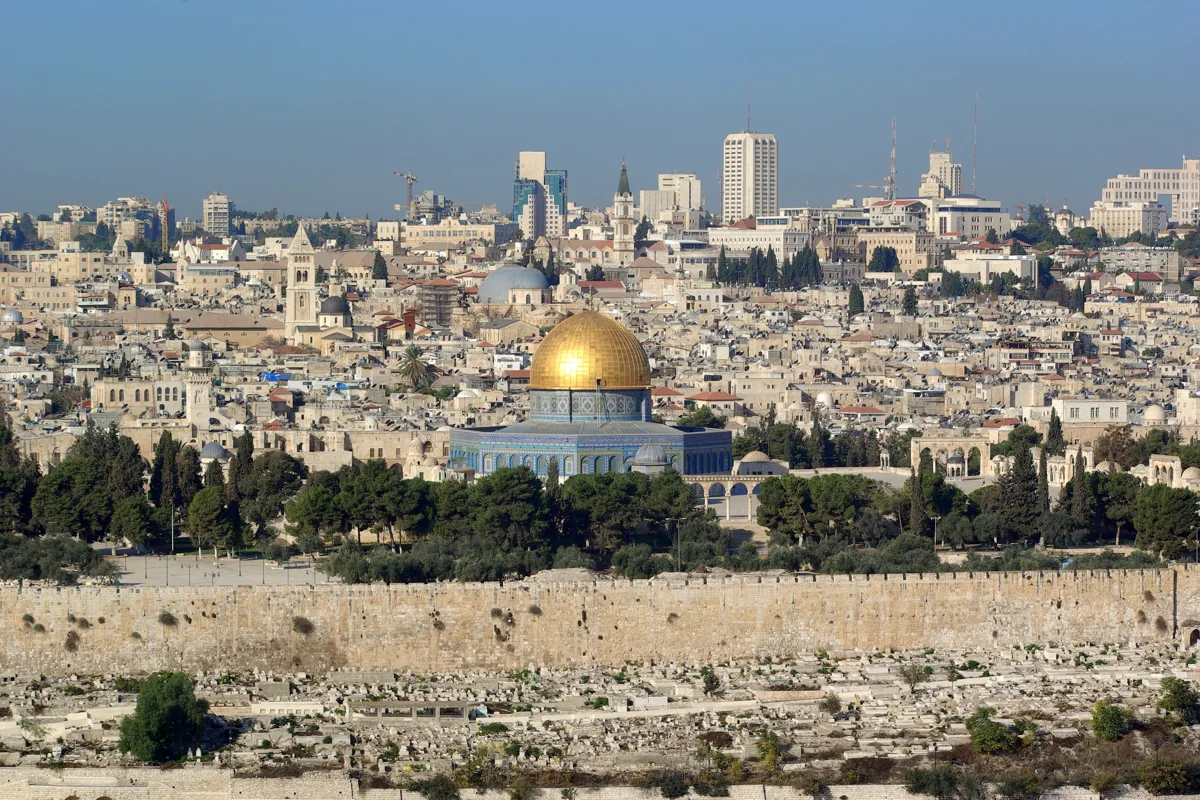

For Jews, the Temple and the memory of its destruction keep the city at the heart of the story. But Jerusalem also becomes central to Christianity and Islam. The Church of the Holy Sepulchre belongs to its Christian history; the Dome of the Rock and the Muslim conquest belong to another major transformation of the city.[5]
The walls that visitors see today are largely associated with the rebuilding ordered by the Ottoman sultan Suleiman in the sixteenth century. That is a useful reminder: a place can feel ancient while the thing immediately in front of us belongs to a much later chapter.[5]
The modern city has its own breaks: British forces take it in 1917, the 1948 war divides it between Israeli and Jordanian control, and Israel captures East Jerusalem and the Old City in 1967 (see the Six-Day War).[5][13]
A readable history of Jerusalem therefore needs more than a parade of conquerors. It needs the city’s changing religious life and its people, as well as the governments that ruled it. Jewish attachment is not made less real by acknowledging Christian and Muslim attachment. The city’s difficulty is that these attachments meet in the same streets.
Syria and the struggle over Greater Syria
The 1948 war (entry 56) is often pictured as Israel on one side and an Arab bloc on the other. That is too simple. Joshua Landis’s chapter, “Syria and the Palestine War: fighting King ʿAbdullah’s Greater Syria Plan”, turns attention to the rival ambitions within the Arab world.[1]
In Landis’s account, Syrian leaders fear that King ʿAbdullah’s dealings with Zionist leaders could help the Hashemites become the dominant regional power. From Damascus, the issue is not only what happens in Palestine. It is also whether Syria’s future will be shaped by a powerful neighbour’s ambitions.[1]
This is the meaning of “fighting” in the title: resistance to ʿAbdullah’s Greater Syria project. It is not the name of a separate battle. The chapter’s argument helps explain why governments apparently supporting the same cause might act at cross-purposes.[1]
The wider lesson fits the much longer story. The land around Jerusalem has repeatedly been caught between regional powers. Assyria, Babylon, Persia, Greece and Rome were not the same kind of states as modern Syria and Transjordan, but the geographical problem is familiar: decisions about this small country are also made in larger struggles around it.
That does not make the people living there passive or unimportant. It means that local events cannot always be explained locally. Landis’s interpretation adds a regional layer to 1948, without replacing the Jewish and Palestinian experiences of the war. The publisher’s page provides a useful summary; access to the complete chapter or PDF may require a subscription.[1]
A Master Timeline: 2000 BC–2026 AD
The principal milestones in one table; each links to its full entry above.
Sources & further reading
Small numbered links lead here so the main story stays readable. Sources include scholarship, museums, historical reference works and the UN; they do not all share the same viewpoint. Useful starting points for deeper study: The Cambridge History of Judaism (source 9), the Jewish Virtual Library (5, 11), Yeshiva University Libraries (19), the US Holocaust Memorial Museum (8) and Teach Jewish History (18).
- Syria and the Palestine War — Cambridge University Press
- The Tunnels of Gaza — Modern War Institute, West Point
- Abraham’s Children in the Genome Era — Atzmon and colleagues
- Timeline for the History of Jerusalem — Jewish Virtual Library
- Creation of Israel, 1948 — US Office of the Historian
- United Nations — About the Nakba
- US Holocaust Memorial Museum — Introduction to the Holocaust
- Cambridge History of Judaism — The Diaspora before 70 CE
- World History Encyclopedia — Abraham, the Patriarch
- Jewish Virtual Library — Timeline for the History of Judaism
- HistoryCentral — Timeline of Israel History
- United Nations — History of the Question of Palestine
- Merneptah Stele — overview and scholarly references
- October 7 attacks — overview and source references
- History of Israel — overview and scholarly references
- Israel Central Bureau of Statistics — Jewish population estimates and Holocaust survivors in Israel
- Teach Jewish History — a chronological guide to Jewish history
- Yeshiva University Libraries — resources on ancient Jewish history
Original, AI-assisted essays. Biblical traditions are identified as traditions; historical dates are approximate where stated. This is a broad history, not live reporting. The Six Challenges chronology and other articles are separate pages.